No products in the cart.

by
IPL Versus Laser for Veins: Which Is Better?
0 Comments

by
0 Comments
October 29, 2026 in Uncategorized
Visible red, purple, or blue vessels can make otherwise healthy-looking skin feel harder to feel confident in. When comparing IPL versus laser veins treatments, the better choice is rarely about which technology is more powerful. It is about matching the right treatment to the type, size, location, and color of the vessel, as well as your skin tone and goals.
Both options use light energy to target unwanted blood vessels without surgery. Yet IPL and vascular lasers work differently, and those differences matter. A personalized medical assessment helps ensure treatment is selected for safe, natural-looking improvement rather than a one-size-fits-all approach.
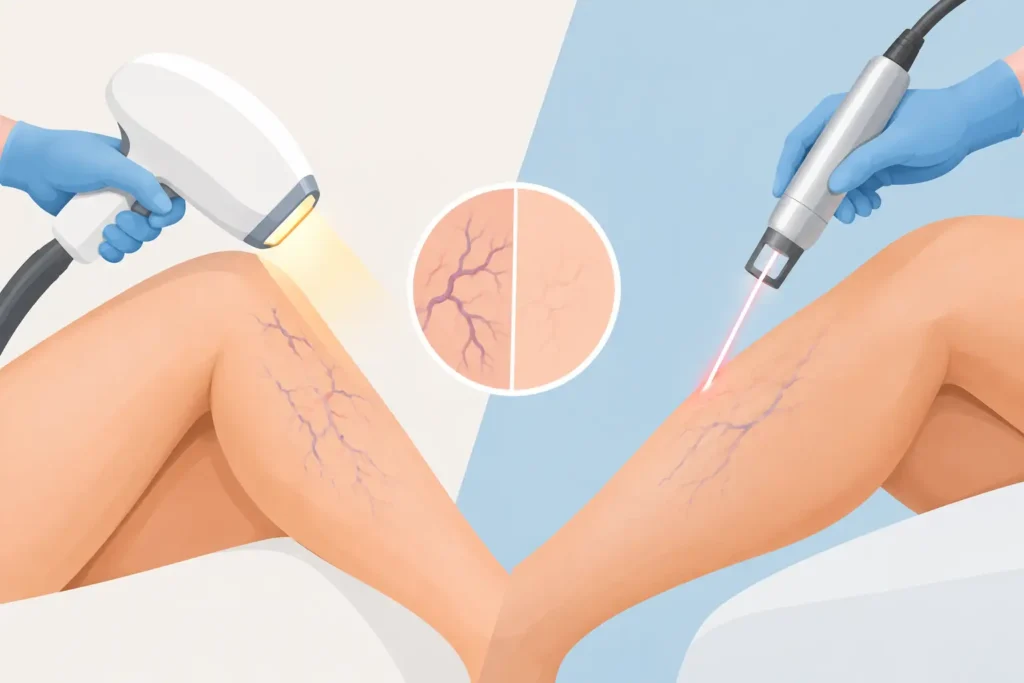
IPL, or intense pulsed light, is not technically a laser. It delivers a broad spectrum of light through filters, allowing a provider to target pigment and redness across a wider area of skin. This makes IPL especially useful when visible facial capillaries appear alongside sun damage, uneven tone, freckles, or generalized redness.
A vascular laser uses a single, concentrated wavelength designed to be absorbed by hemoglobin, the pigment in blood. As the vessel absorbs that energy, it heats and gradually closes. The body then clears the treated vessel over time. Because the light is more focused, a vascular laser can offer greater precision for distinct spider veins and certain larger or deeper visible vessels.
Neither treatment simply “erases” every vein in one appointment. Results develop as the body responds, and multiple treatments are often recommended depending on the concern. The goal is clearer, more even-looking skin with a treatment plan built around realistic expectations.
IPL is often a strong option for diffuse redness rather than isolated leg veins. For example, someone with flushing around the cheeks, tiny broken capillaries around the nose, and uneven pigment from sun exposure may benefit from IPL because it can address several visible concerns in the same treatment area.
It may be considered for very fine, superficial facial vessels, particularly when redness is widespread. The broad coverage can be efficient for full-face rejuvenation, helping skin look brighter and more balanced while reducing the appearance of selected vessels.
There are trade-offs. IPL is generally less targeted than a vascular laser, so it may not be the preferred choice for a clearly defined, larger spider vein. It is also not usually the first choice for leg veins, where vessels can be deeper and require a more specialized approach. A consultation should assess whether IPL is likely to deliver meaningful improvement for the specific vessels you see.
A vascular laser can be an excellent choice for individual, well-defined vessels, including facial spider veins and selected superficial leg veins. Its focused energy allows a clinician to treat each vessel with precision while limiting exposure to surrounding skin.
Laser treatment may be particularly helpful when vessels are blue, purple, or red and do not sit within a larger area of pigment or general facial redness. The wavelength, spot size, and energy settings can be adjusted according to vessel depth and diameter. This degree of customization is one reason treatment should be performed under qualified medical supervision.
For leg spider veins, a laser may be used alone or as part of a broader treatment plan. However, larger, raised, bulging, or rope-like veins are not a cosmetic light-treatment concern alone. They may reflect an underlying circulation issue and need medical evaluation. Treating only the visible surface vessel without understanding what is feeding it can lead to disappointing results or recurring veins.
The face and legs behave very differently when it comes to visible vessels. Facial capillaries are often shallow and can be associated with rosacea, sun exposure, genetics, or skin sensitivity. IPL or laser may be suitable depending on whether the concern is diffuse redness, isolated vessels, or both.
Leg veins can be more complex. Fine spider veins may respond to laser treatment, but deeper feeder veins can require another medical approach. A careful assessment is especially valuable if you notice aching, heaviness, swelling, itching, skin discoloration, or one-sided leg swelling. Those symptoms deserve medical attention before pursuing cosmetic improvement.
Location also affects recovery expectations. Facial redness after treatment may be relatively easy to manage with gentle skincare and sun protection. Legs may require more patience, and visible changes can take weeks as treated vessels fade. Your provider should explain what is normal for the treatment area and when to follow up.
Light-based treatments depend on contrast between the target vessel and the surrounding skin. Melanin also absorbs light, which means treatment planning for deeper skin tones requires particular care. The wrong device, wavelength, or setting can increase the risk of unwanted pigment changes, blistering, or irritation.
This does not mean people with deeper skin tones cannot pursue treatment. It means device selection and conservative, personalized settings are essential. A physician-led practice can assess whether IPL, a specific vascular laser, an alternate treatment, or a staged approach offers the best balance of safety and results.
Recent tanning, self-tanner, sun exposure, certain medications, active skin irritation, and a history of pigment changes can all affect candidacy. Be open about your health history and skincare routine. This information is not a formality. It informs a safer treatment plan.
Most clients describe IPL and laser vein treatments as brief snaps of heat against the skin. Depending on the area and device, cooling methods may be used to improve comfort and protect the skin. A treatment session can be relatively quick, although timing depends on the number of vessels and the size of the area.
Immediately afterward, mild redness, warmth, or swelling may occur. Treated vessels can temporarily appear darker or more noticeable before they fade. This is often part of the normal response, not a sign that treatment failed. Avoiding heat exposure, picking at the skin, and sun exposure supports a more comfortable recovery.
Results are gradual. Fine facial vessels may improve over several weeks, while leg veins can take longer. Some vessels clear beautifully after one session, while others need a series of treatments. New visible vessels can also develop over time because treatment addresses existing vessels, not every underlying factor that contributes to them.
The question is not simply whether IPL or laser is better. A more useful question is: what exactly are we treating? A good consultation identifies whether your concern is facial redness, broken capillaries, sun-related discoloration, fine spider veins, deeper veins, or a combination of these.
At HealX Wellness, treatment planning begins with your skin, your health history, and the outcome you want to see in the mirror. This may mean recommending IPL for a broader redness and rejuvenation goal, laser for targeted visible vessels, or medical evaluation before cosmetic treatment when vein symptoms suggest something more significant.
Clearer-looking skin is possible, but the safest path begins with an honest assessment of the vessels beneath the surface. Choose care that respects both your aesthetic goals and your long-term skin health.
About the author